5 Benefits to In-House Grinding
This machine shop’s in-house grinding capabilities offer many advantages for itself and for its customers, including time and cost savings.


Providing in-house grinding is a benefit to both the machine shop doing the grinding as well as its customers. The in-house process saves time and money, and helps a shop create higher quality parts.
Ripley Machine and Tool Inc. (Ripley, New York), has had in-house grinding capabilities since the 1950s. In 1994, when President Andy Reinwald’s grandfather purchased the company, grinding for other regional machine shops was a larger portion of what the company offered to its customers than what it does today. Reinwald explains that back then there was a big demand for the service because the barstock material quality was not as good as it is today, and the machines were not able to hold sizes (tolerances) as well as they do currently.


I recently talked to Reinwald, a 2019 Production Machining Emerging Leader, to understand more about the shop’s in-house grinding processes and discover what the biggest advantages are. Here are what he says are the top five advantages:
1 – Offering a service to other shops, while also making grinding a profit center.
Although grinding as a service to others might have been more popular in 1994, Ripley Machine still has about 12 regional customers for which it grinds parts. But the company also specializes in CNC milling and turning, and recently bought its first Swiss-type turning center a little more than a year ago. The company has 10 grinding machines to perform internal, centerless barstock, through-feed centerless, in-feed centerless, and center grinding.
Ripley Machine and Tool can through-feed grind parts with a diameter as small as 0.063 inch up to 2-½ inches. The company can hold tolerances as close as 0.0003 inch and surface finishes better than 8 Ra. (Photo credits: Ripley Machine and Tool Inc.)
Ripley Machine can grind customer-supplied material or use one of its qualified vendors to purchase and supply the material. It has experience grinding various materials, including tool steel, stainless steel, aluminum, Hastelloy, brass, copper and more.
For centerless grinding, the shop is capable of grinding bars up to 1 inch diameter at lengths up to 14 feet long. For high production jobs for through-feed centerless grinding, the company uses automatic feeders and air gaging.
For internal grinding, the company is able to grind straight or taper bores and can grind parts with a bore diameter between 0.625 inch and 9 inches with a length up to 7 inches.
2 – Faster access to precision ground barstock.
Ripley Machine’s customers that take advantage of its in-house grinding capabilities save money buying ground stock from Ripley Machine because the shop can do the process cheaper and, therefore, charge less than a mill would. Also, instead of waiting one to two weeks for barstock to be ground and delivered from a mill, it typically takes Ripley only a couple days to precision grind stock in-house.

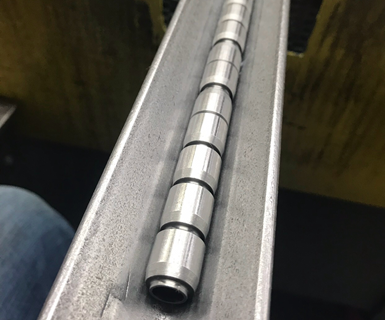
These OD and ID ground sleeves have been machined at Ripley Machine and Tool’s in-house grinding facility in Ripley, New York.
Now that Ripley Machine, a 2018 Modern Machine Shop Top Shops winner, is doing some Swiss machining, having easier access to precision ground barstock has been invaluable. “It is significantly quicker because we can have ground material set up in one day,” Reinwald explains. “One of our material suppliers can typically have it to us by the next day. And as soon as it gets here, we have our grinder ready to go. We eliminate so many middlemen and gaps.” He adds that it is a lot less expensive to precision grind his own stock because he can control the cost.
3 – Production on the Swiss-type machine starts sooner.
Having in-house grinding also means having the ability to use the grinders more efficiently to get the ground barstock shipped out sooner. When ground barstock is purchased from a mill, customers normally must wait for the entire order to be ground and shipped. “We can get one bar ground, get it over to our Swiss setup guys and have our Swiss team work on the initial parts and get the setup running smoothly,” Reinwald says. “Simultaneously, the grinder is still running the rest of the material for the production order.”
4 – Improving size, tolerance and finish of barstock prior to machining.
The quality of bar that is put into a Swiss-type machine is the same quality of part that will come out of it. Reinwald says sometimes stock material that has been purchased from the mill will not meet certain finish and size requirements for a job on a Swiss machine. Therefore, having the ability to create ground bar to the size and finish necessary can be the only way to satisfy a customer.
“One shop we work with needed to have a bar a certain size, and they needed it ground down to fit into a collet rather than buying a guide bushing and at least one collet, maybe two,” Reinwald explains. “Their potential costs would have been at least a couple hundred bucks and whatever lead time. For us, though, it was a small bar that was less than a hundred dollars to grind.”
5 – Creating better surface finishes than what is possible by turning alone.
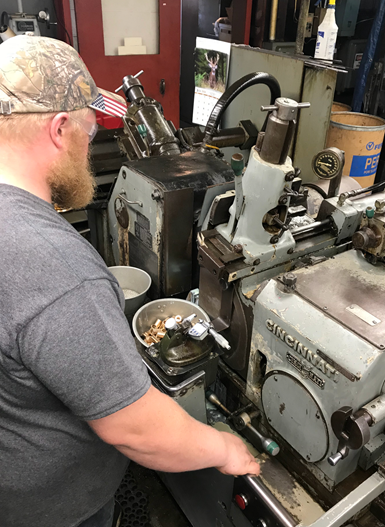
Ripley Machine’s in-feed grinder can grind up to 4” in diameter and as long as 6”. The company’s machines can hold tolerances to 0.0003” and surface finishes better than 8 Ra.
When parts that have been machined on a lathe or Swiss or even on one of Ripley’s mills do not meet surface finish requirements or are perhaps marred from workholding, it is possible to grind the part after machining to meet finish requirements. Reinwald says the company might use one of its grinders to take off 5 tenths to a thousandth of an inch in total diameter on a part to ensure a good finish.
He adds his shop might grind a round part when both ends need to be machined.


Related Content

Holding Aerospace Tolerances 24/7 in Central Wisconsin
Exceedingly challenging machining applications have a way of becoming achievable with the right team and equipment. Pointe Precision offers a case in point with its new automated fuel metering valve grinding and measurement cells.
Read More
Should You Bring Tool Regrinding In-House?
In some situations, the potentially high investment in an in-house tool grinding process can be justified with a relatively fast ROI. (Includes video.)
Read More
In-Machine Probing Possibilities for VTLs
A manufacturer of vertical turning centers uses a “push/pull” optoelectronic probe with custom bracket to enable its machines to perform effective, in-process measurement of shafts and related automotive components.
Read More
Laser Technology "Turns" into a Turning Tool
This new technology uses a laser to act as a cutting tool to "turn" parts from solid barstock. This high-speed precision turning machine is especially useful for micromachining, enabling high accuracy for small, complex parts that are often delicate and difficult to machine when implementing conventional turning processes.
Read MoreRead Next

Production Machining Readers Among “Top Shops”
Modern Machine Shop’s Top Shops program honors shops that fall in the top 20% of its annual benchmarking survey. These Production Machining readers have received this recognition.
Read More
How To (Better) Make a Micrometer
How does an inspection equipment manufacturer organize its factory floor? Join us as we explore the continuous improvement strategies and culture shifts The L.S. Starrett Co. is implementing across the over 500,000 square feet of its Athol, Massachusetts, headquarters.
Read More
Finding the Right Tools for a Turning Shop
Xcelicut is a startup shop that has grown thanks to the right machines, cutting tools, grants and other resources.
Read More