
Aqueous Processes Offer Safe, Effective Cleaning
Environmental concerns and safety issues are pushing manufacturers to replace chlorinated solvents with water in cleaning processes. Understanding aqueous cleaning processes is critical to knowing whether or not to make the switch.


Increasing environmental concerns and safety issues associated with chlorinated solvents is leading many manufacturers to consider aqueous cleaning processes. Ozone depletion, worker safety considerations and updated regulations from the Environmental Protection Agency (EPA) and Occupational Safety and Health Administration (OSHA) regarding air, water and soil contamination are all concerns of companies using chlorinated solvent cleaners.
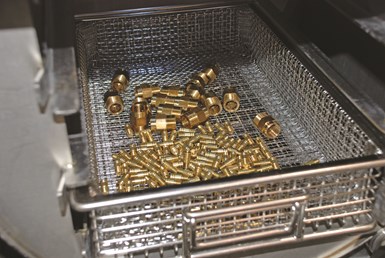
Hubbard-Hall offers the following information to help precision machine shops understand ultrasonic and mechanical cleaning, which are aqueous processes that can replace chlorinated solvent cleaning.


Ultrasonic Cleaning
Ultrasonic cleaning builds upon the concept of soak cleaning with the additional use of high-frequency sound or ultrasonic waves. A combination of chemistry and this form of energy effectively removes a variety of soils including but not limited to oils, greases, buffing and polishing compounds, paraffins and waxes, abrasives, rouges, metallic chips, fragments and shavings.
An ultrasonic generator, coupled with a transducer unit, changes the signal to mechanical energy which, in turn, produces a cavitation action that scrubs parts clean. In the working solution, cavitation intensity increases as the temperature of the cleaning solution increases. This usually holds up to a solution temperature of 160°F (71°C). Beyond this temperature, cavitation steadily decreases.
The careful racking or fixturing of parts is one of the keys to ultrasonic cleaning success. . This maximizes exposure to the desired levels of ultrasonic energy, thereby enhancing the effectiveness of the cleaner chemistry. Design and fixturing of parts promotes good solution drainage, prevents air entrapment and allows for penetration of ultrasonic energy. Similarly, there is an optimal alignment of transducer to parts, so routine maintenance of the transducer is crucial to performance.
There are a variety of criterion to consider when choosing the appropriate cleaning process. Aluminum, brass, white metal and zinc are the metals most commonly cleaned ultrasonically. It’s important to choose the chemistry which is compatible with the substrate being cleaned. Ultrasonic cleaning solutions normally provide formulations in the pH range of 8 to 13. Cleaning nonferrous or more sensitive metals may also require inhibitors in the cleaner concentrate. Ultrasonic cleaning may be the first step in surface preparation or it may precede a soak cleaner.
If cleaning the parts is the sole requirement, proper drying is essential. Mechanical dryers such as spin units, hot air knives, or centrifugal types are most commonly used for this purpose.
Mechanical Cleaning
Mechanical cleaning can make quick work of soil removal. It is an economical yet effective method for bulk cleaning stamped and mechanically formed parts. It is particularly effective when used with paint, powder coat and phosphate lines.
This type of cleaning combines chemical and mechanical energy. Its comparatively lower temperature requirement — ranging from 120 to 150°F (49-66°C) — reduces heating costs as it lowers energy demands. Sprays and other forms of agitation during the cycle provide significant mechanical force, improving the overall removal of soils.
Cleaner blends are low foaming and blended with powerful solvents (SARA Title III exempt types), dispersants and water conditioners (to prevent the plugging of spray nozzles). The pH of cleaners range from near neutral to 14. Blends are available for all sensitive metals, nonferrous and ferrous types.
The appropriate mechanical action for the job at hand is critical to cleaning success.
In spray cleaning, the PSI application is important for part coverage and the optimization of soil displacement.
In wash machines, agitation trays or baskets of parts are placed in sealed compartments. Up/down, rotational and/or side-to-side action occurs. For optimal performance, racking of parts or placement in bulk tubs must be considered in parts configuration or design.
To extend cleaner bath service life, waste treatment can be simplified. Also, recirculation tanks can be continually skimmed to remove oily and grease soils.
Using a combination of the right chemistry, equipment and cleaning process can help manufacturers achieve the necessary part cleanliness standards while meeting increasing regulatory requirements.


Related Content

A ‘Clean’ Agenda Offers Unique Presentations in Chicago
The 2024 Parts Cleaning Conference, co-located with the International Manufacturing Technology Show, includes presentations by several speakers who are new to the conference and topics that have not been covered in past editions of this event.
Read More
Overcoming 3 Common Challenges With Automated Particle Counting
Facing difficulties while performing particle analysis is normal but should not be discouraging. Here are some ways to handle the most prevalent issues that can arise.
Read More
Miraclean Tanks Enable Highly Configurable Cleaning System
PMTS 2025: Miraclean’s cleaning systems consist of individual ultrasonic or static tanks in a standard size that can be organized within a stainless-steel frame.
Read More
Kyzen Solvents Provide Ease of Cleaning for Medical Parts
The Metalnox line of solvent products are designed to improve reliability and increase the ease of cleaning in vacuum and vapor degreasing processes.
Read MoreRead Next

How To (Better) Make a Micrometer
How does an inspection equipment manufacturer organize its factory floor? Join us as we explore the continuous improvement strategies and culture shifts The L.S. Starrett Co. is implementing across the over 500,000 square feet of its Athol, Massachusetts, headquarters.
Read More
Finding the Right Tools for a Turning Shop
Xcelicut is a startup shop that has grown thanks to the right machines, cutting tools, grants and other resources.
Read More