
SW Twin-Spindle Machining Center Boosts Production of Large-Scale Components
SW North America’s BF 12-21D machining center is optimized for large-scale automotive structural component manufacturing.


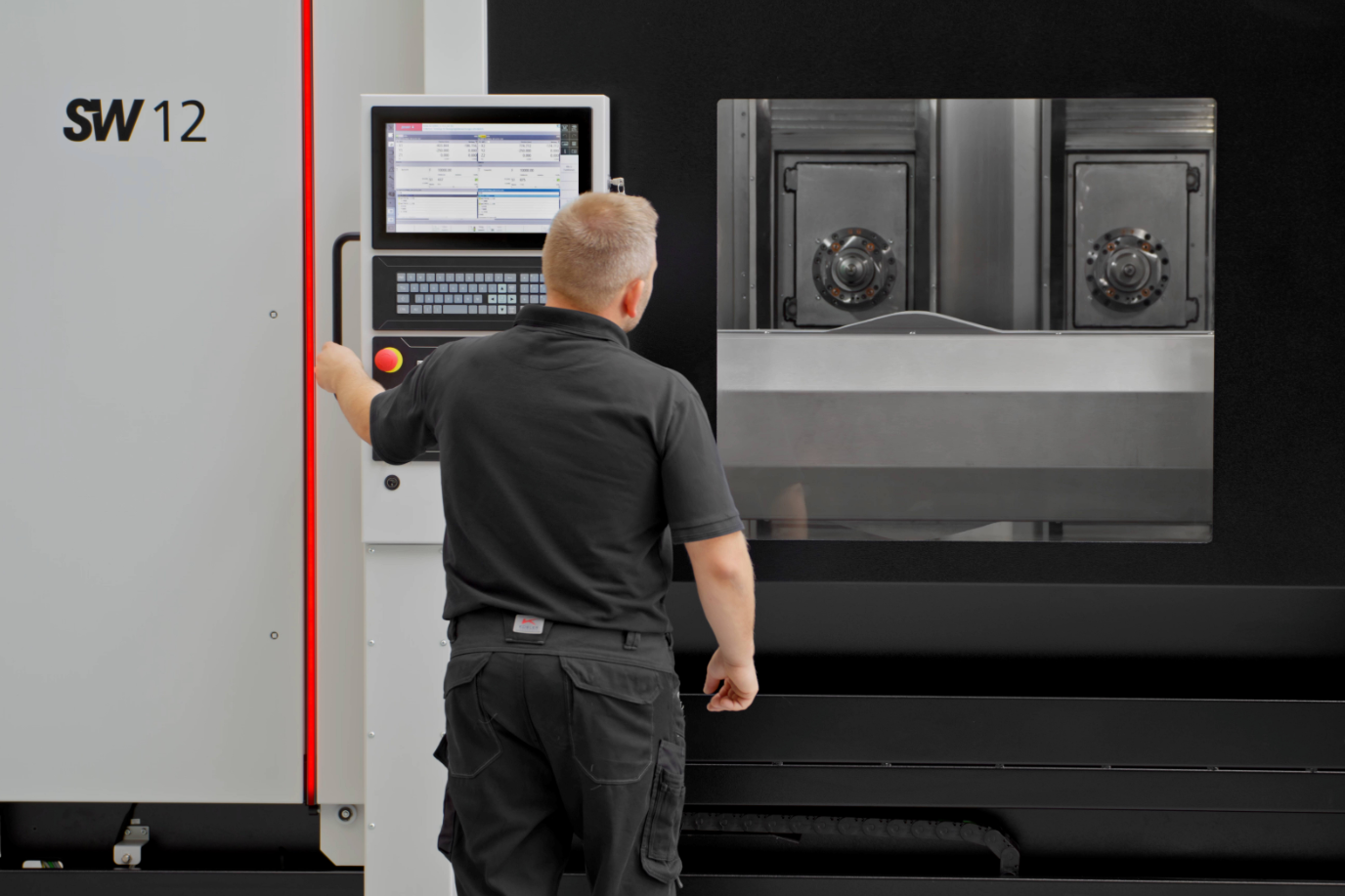
SW North America’s BF 12-21D machining center is optimized for die-cast aluminum-body automotive parts, particularly for the large-scale production of vehicle body and chassis components. The BF 12-21D is said to provide a cost-efficient solution for applications with higher manufacturing tolerances.
The BF 12-21D features a hybrid drive system, in which the X- and Z-axes are driven by linear motors, while the Y-axis is driven by ball screws. The drives achieve a maximum dynamic speed of up to 120-m/min rapid traverse and 20-m/s² acceleration. The machine’s two spindles feature independent three-axis units, enabling the machine to meet the demands of production lines with high manufacturing volumes.


Both spindles have their own tool magazine and operate in separate working areas but can also work together in one working area. For example, during automated component changeover in one working area, the second spindle can provide support in the other area. The resulting possibility of quasi-parallel loading during main processing time further increases productivity. Standardized communication interfaces for automation and MES systems as well as an integrated tablet allow for easy status and remote monitoring of the system, helping maximize machine availability.
“Die-cast aluminum parts are being used more and more frequently in vehicle body construction,” says Michael Kreuzberger, product manager at SW. “Manufacturing accuracy plays a less important role for such workpieces than for parts like gearbox or stator housings — but producing them economically is all the more important.”
“As a twin-spindle machine, the BF 12-21D ultimately functions like two machines in one,” Kreuzberger adds. “In terms of performance, it replaces two conventional single-spindle machines but only requires one set of machine peripherals, (i.e., only one control system, one control cabinet, one hydraulic unit, one cooling lubricant system and so on). It can thus achieve a significantly higher output with a smaller footprint.”
Related Content
-
SW North America Twin-Spindle Machining Center Enables Fully Autonomous Operation
Eastec 2025: The BA 322i is well suited for machining complex aerospace components that require tight tolerances and high-quality finishes.
-
Precision Machining Technology Review: April 2025
Production Machining’s April 2025 technology showcase includes some of the latest technology from Sumitomo, Hurco, Supertec, SMW Autoblok, SW North America and Tungaloy.
-
3 Flavors of Five-Axis Machines
A range of five-axis machining center platforms are available to suit specific production needs such as improved accuracy, better surface finishes and unattended operation.


