
Production Machining Readers Choose April as Favorite Cover from 2022
The results of our recent cover survey reveal that a shot of a B-axis Swiss-type’s workzone was the most intriguing to survey participants.


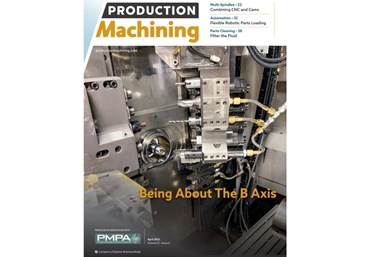
Here is the Production Machining cover that recent survey participants chose as their favorite from 2022. Click here to receive the magazine in print and/or digital form.
In what I’d call an old-school yet neat shot, participants in our 2022 Production Machining favorite cover survey chose the April issue shown to the left.
That cover story highlights Salt Lake City’s Paramount Machine, which is not afraid to run jobs of a mere five pieces on its Tsugami America Swiss-types such as the one I photographed for the cover.


All of the Tsugamis are “convertible” models, and one part of the shop’s strategy with its Swiss-types is keeping them in chucker mode most of the time and scheduling accordingly, unless a job requires a guide bushing. The shop says these machines run in chucker mode 80% of the time. This helps by reducing changeover time to new jobs. The time to change from chucker and guide bushing modes is only 30 to 45 minutes.
You can read this article and others in April’s digital edition. And, if you’re not receiving Production Machining in either print or in digital form, and/or are not receiving our e-newsletters, click here to subscribe.
Thanks to all of you who participated in our survey. Five participants chosen at random will soon receive some free PM swag.
We’ll do it again next year!
Related Content
-
A History of Precision: The Invention and Evolution of Swiss-Style Machining
In the late 1800s, a new technology — Swiss-type machines — emerged to serve Switzerland’s growing watchmaking industry. Today, Swiss-machined parts are ubiquitous, and there’s a good reason for that: No other machining technology can produce tiny, complex components more efficiently or at higher quality.
-
A Contract CNC Shop in Transition
Denver Precision Products is in a transitional mode in two respects: company leadership and adoption of new multifunction machining technology and processes.
-
Does a Scanning Probe Make Sense on a Swiss-Type?
Swiss-types have limited tooling capacity, but there can be advantages to giving up some of that capacity to take advantage of a touch probe — in fact, a scanning probe — to enable in-process part measurements.


