
Hybrid Quick-Change Collet Chuck Converts to Mandrel
PMTS 2023: SMW Autoblok’s hybrid Comot-AZ quick-change collet chuck quickly changes from a collet chuck to a mandrel in seconds.


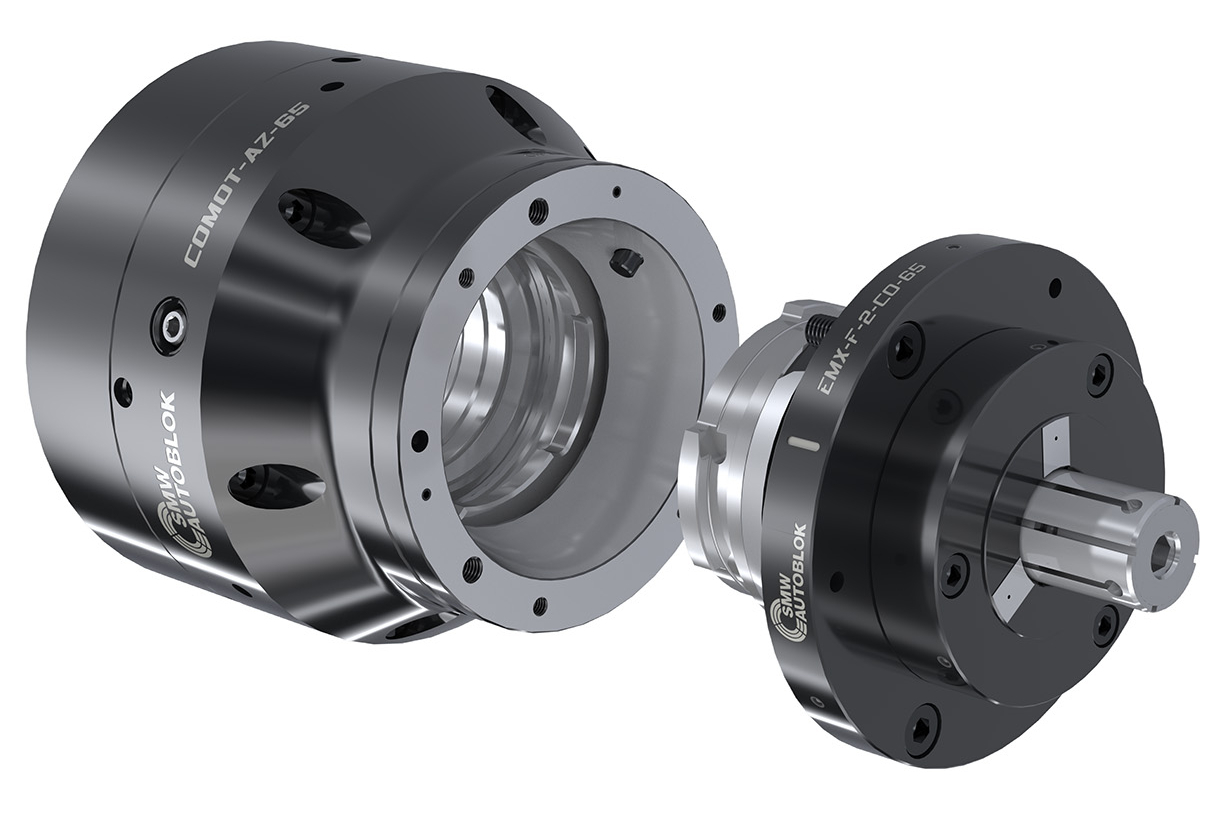
SMW Autoblok’s hybrid Comot-AZ quick-change collet chuck. Photo Credit: SMW Autoblok
SMW Autoblok’s hybrid Comot-AZ quick-change collet chuck features industry-standard diameter capacities of 42, 65 and 100 mm to accommodate a variety of workpiece sizes. The company says it is well suited for bar and tubular stock machining that requires multiple daily changeovers.
The Comot-AZ can be used in three ways: for OD machining using standard collets; for greater accuracy utilizing high precision collets with Comot-AZ/PA; and to quickly transform the Comot-AZ into an expanding mandrel for ID clamping using the EMX series.


The chuck can be used for hard turning, gear grinding, drilling, milling and more. It provides low deformation clamping of thin-walled workpieces and offers a selection of standard collets available in round, square, hexagonal and special configurations when needed for a variety of spindle sizes.
The optional Comot-AZ/PA enables users to change from a standard collet to a high-precision collet for holding workpieces from 3 to 100 mm with accuracy and repeatability. The EMX series extension mandrel is also available for internal workpiece fixturing.
For automated loading, Comot-AZ also provides air sensing to ensure the part is seated properly before the machine cycle starts. Other advantages include radial fine adjustment and a case-hardened body and internal parts for high resistance and longer life.
Related Content
-
Bar Feeder Designed with Swiss-Types in Mind
New technology enables this bar feeder to fully support the bar pusher and stock from inside the unit all the way to the spindle of a sliding headstock lathe.
-
Precision Machining Technology Review: December 2024
Production Machining’s December 2024 technology showcase includes some of the latest technology from Hexagon, Kennametal, SmartCAM, Horn and SMW Autoblok.
-
What’s the Right Bar Feeder for Your Machine Shop?
Machine shops likely have questions about what type of bar feeder makes most sense for their operational needs. One or more of these four might be floating around in your head.


