
Starrag’s Bumotec 191 Neo Turn-Mill Reduces Tool Change Time
The company says the 191 Neo turn-mill can also be used for grinding, polishing, skiving, gear hobbing and diamond cutting with no setup or fixture changes.


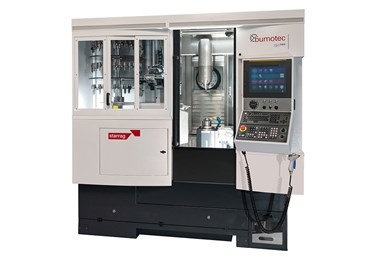
Starrag’s Bumotec 191 Neo seven-axis turn-mill center. Photo Credit: Starrag
Starrag says its Bumotec 191 Neo seven-axis turn-mill is designed for lean manufacturing, offering reduced tool change time, faster backworking movement and a higher torque (175 Nm) milling spindle. The result is a machine that is said to enable users to achieve lower piece part costs.
The turn-mill features an ergonomic design that includes large window areas, so operators can clearly see all working zones, as well as well-positioned doors for easy access. The machine can accommodate bar of 42 mm, 50 mm and 65 mm, and has 50 m/min traverse rates for its X, Y and Z axes travels of 410 mm, 200 mm and 400 mm, respectively.


Main spindle options extend up to 22 kW with a torque rating of 175 Nm, while the 15 kW/36 Nm subspindle operates at 6,000 rpm. In addition to milling and turning routines, the 191 Neo can also be used for grinding, polishing, skiving, gear hobbing and diamond cutting with no setup or fixture changes.
The turn-mill is available in four options, including the P model with vice, PRM with multipurpose pickup vice, R with backworking spindle and an RP version with combined vice and backworking spindle.
The company says the machine is very stable during production and offers a 90-position tool magazine that operates in parallel with integrated tool breakage probing. It also features a pallet system and is configured for a robotic, modular or custom-made automated cell. Other options include a temperature-controlled, high-pressure chip conveyor and bar loading.
The machine is said to offer compatibility with the latest production technologies and remote access management, including a touch display with user-friendly and intuitive interface that can be easily and quickly used to swipe between screens. This enables users to monitor the progress of current machining operations, configure programming or track production in real time.
Related Content
-
5 Tips for Multichannel Programming
Programming for multitasking machines can be complex. Knowing several key points for making the process less challenging can save a programmer time as well as lessen confusion and the risk of error.
-
5-Axis Machining Centers Transform Medical Swiss Shop
Traditionally a Swiss machine shop, Swiss Precision Machining Inc. discovers a five-axis machining center that has led the company to substantial growth. (Includes video.)
-
Does a Scanning Probe Make Sense on a Swiss-Type?
Swiss-types have limited tooling capacity, but there can be advantages to giving up some of that capacity to take advantage of a touch probe — in fact, a scanning probe — to enable in-process part measurements.


