Making Small Parts
It still amazes me how small some of the parts can be in our industry. Although it looks like it might be just a chip, this medical component has an 8-thousandths hole through it with four mills along the sides.


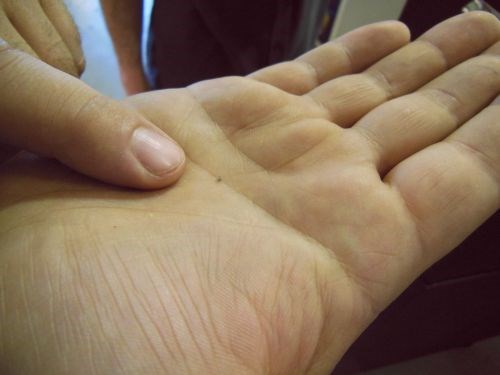


It still amazes me how small some of the parts can be in our industry. Earlier this year I visited a shop in Barrington, Ill. (near Chicago) that runs a large range of products, from hydraulics to medical to aerospace to connectors. While the majority of my visit focused on Swiss Automation Inc.’s highly effective solution to hiring and training operators (see “A Swiss Shop’s Next Generation”), Foreman Marc Moran seemed proud to show me around the shop floor, sharing other cool things the company is doing to keep pace with the competition and meet customer demands.
One of the company’s strengths is its ability to deliver precision parts of various sizes quickly. All parts produced here come off of the machines complete, with no secondary operations. The part pictured above was made on a Deco machine from Tornos Technologies U.S. This medical component has an 8-thousandths hole through it with four mills along the sides. Marc says, “It’s almost like a sliver. It looks like just a chip from one of our other machines.” I know I have weak eyes, but I can barely see anything in Marc’s hand.
Producing these tiny parts is only part of the equation. Equally challenging is the inspection process, verifying that they meet the quality standards. With inspection stations strategically placed throughout the shop floor, as well as two quality control rooms, Swiss Automation takes its inspection processes seriously. In fact, all new shopfloor employees and apprentices begin in this department to get a fundamental understanding of its significance.
Related Content
-
Laser Technology "Turns" into a Turning Tool
This new technology uses a laser to act as a cutting tool to "turn" parts from solid barstock. This high-speed precision turning machine is especially useful for micromachining, enabling high accuracy for small, complex parts that are often delicate and difficult to machine when implementing conventional turning processes.
-
5 Tips for Multichannel Programming
Programming for multitasking machines can be complex. Knowing several key points for making the process less challenging can save a programmer time as well as lessen confusion and the risk of error.
-
CAM-Driven Lathe Questions
There can be hidden issues using legacy cam-driven lathes that can be overcome using new CNC technology. Here are three to keep in mind.


