
Ceratizit Standard Insert Grades for Optimized Steel Turning
The inserts are engineered for increased productivity and feature advanced substrates, geometries and Ceratizit’s Dragonskin multilayer coating for lower heat and less tool wear.


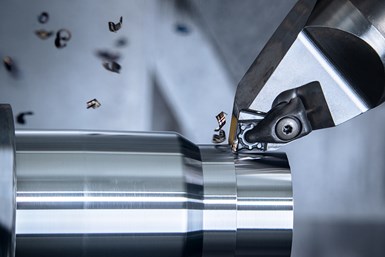
The gold-colored TiN outer layer of the Dragonskin multilayer CVD Ti(C,N)/Al2O3/TiN coating acts as an indicator to help prevent insert waste and easily detect wear. Photo Credit: Ceratizit
Ceratizit has three new standard coated-carbide ISO-P steel insert grades for common steel turning operations which are said to provide up to 20% longer tool life when compared to previous generation grades. The inserts are highly engineered for increased productivity and feature advanced substrates, geometries and Ceratizit’s Dragonskin multilayer coating for lower heat and less tool wear, the company says.
To prevent insert waste and easily detect wear, the gold-colored TiN outer layer of the Dragonskin multilayer CVD titanium carbonitride (Ti(C,N))/aluminum oxide (Al2O3)/Titanium Nitride (TiN) coating acts as an indicator. It not only enables users to clearly identify insert wear and index before a breakage but also prevents sharp cutting edges from going unused and the insert being inadvertently discarded.
In addition, a mechanical postcoating treatment is said to produce beneficial residual stress in the coating which results in increased process security. Extra security can be especially important in large-volume production situations typically associated with turning ISO-P steels.
Each of the three grades are engineered for optimizing specific production scenarios. The CTCP115-P (ISO P15) grade has enhanced resistance to high temperatures and is well suited for use at higher cutting speeds in smooth, continuous cuts in stable cutting conditions. The CTCP125-P (ISO P25) universal steel-cutting grade is said to balance toughness and wear resistance to provide consistent reliability in turning operations ranging from finishing to rough machining. The CTC135-P (ISO P35) is a tough carbide grade for lower cutting speeds, interrupted cuts and unstable machining conditions.
Related Content
-
Cutting Tool Considerations for Hydraulic Port Machining
Indexable insert cutting tools can boost the efficiency of port machining processes by creating multiple features in a single operation.
-
Increased Competition Calls for Smarter Solutions
Engineered for efficiency, SW Machines offers customers a full suite of horizontal machining centers and the automation needed for high-volume, high-precision manufacturing.
-
German Project Yields Three New Medical Machining Processes
Recent research has resulted in a new mix of high-speed turn whirl milling, polygon turning and rotational turning for manufacturing medical bone screws and out-of-round nails.


