Digilog Probe for In-Process Surface Roughness Measurement
Caron Engineering’s DTect-IT CNC sensor analysis system uses the Blum-Novotest TC64 RG Digilog Probe as the sensor input for in-process surface roughness analysis.


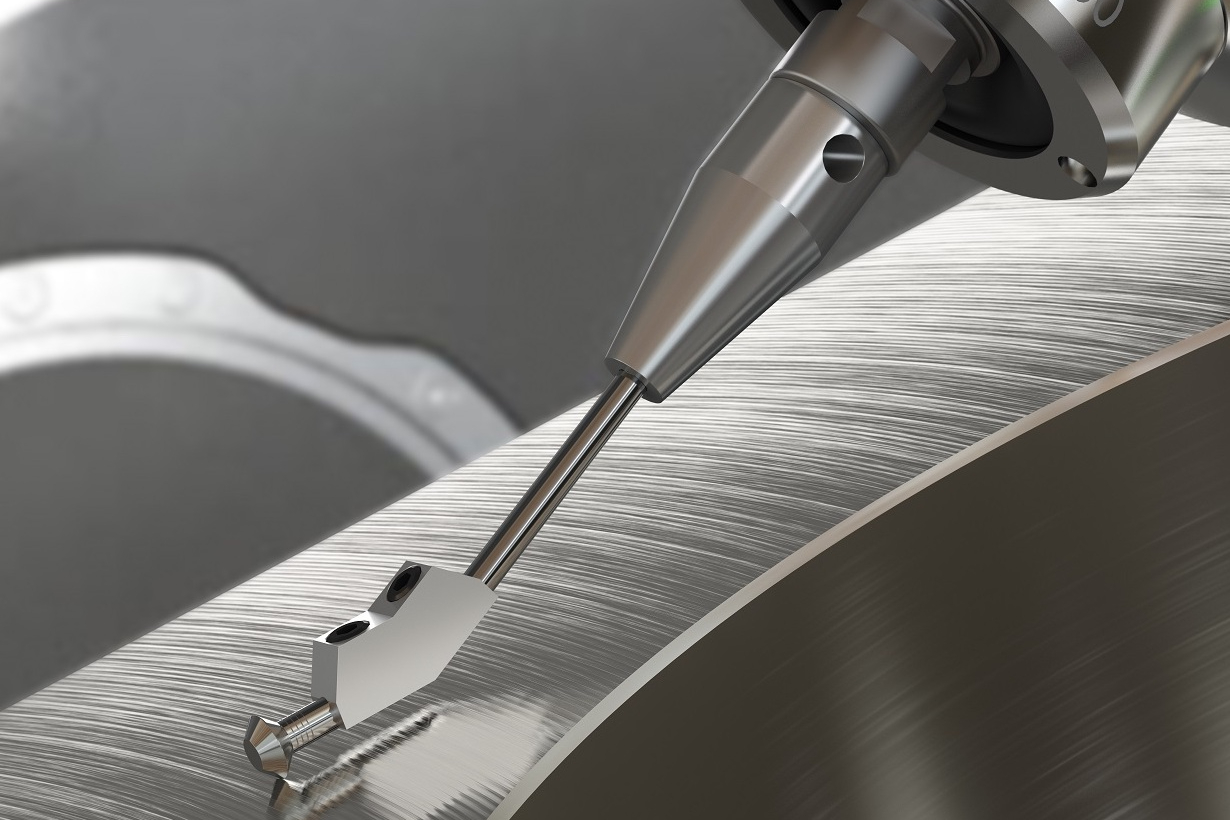
Blum-Novotest TC64 RG Digilog Probe. Photo Credit: Caron Engineering
Caron Engineering has added the Blum-Novotest TC64 RG Digilog Probe to the suite of applications for its DTect-IT product for in-process surface roughness measurement.
The DTect-IT is a versatile CNC sensor analysis system that takes in data from a multitude of high-precision sensors. The surface roughness measurement application uses the Blum-Novotest TC64 RG Digilog Probe as the sensor input in DTect-IT to analyze the surface of a part.


The company says the surface roughness measurement verifies the surface finish result. The ability to have automated in-machine surface roughness measurement gives manufacturers the fast capability to measure every part for optimum finish. This technology also gives insight as to cutter health by looking at the surface finish each time a tool cuts.
For the analysis, the CNC program scans the surface of a part with the probe stylus. The TC64 probe uses a 10 micron radius tip to provide high-resolution scanning. The DTect-IT software collects the scanned data from the probe and, using NIST-traceable algorithms, calculates the surface roughness.
The roughness report is displayed on the DTect-IT HMI (Human Machine Interface) immediately following the probe scan. DTect-IT handles all required filtering and enables users to set scanning parameters based on the type of surface finish being measured. Results can be metric or imperial and include Ra, Rz, Rsm and Rmax.
“Before this technology became available, the only way to measure surface finish was to remove the part and use a special surface roughness gauge which proved both time-consuming and challenging to accurately measure all surfaces of the part,” says Rob Caron, president of Caron Engineering. “This new technology allows in-machine measurement and, because the probe can be oriented to any angle, it can scan any surface the machine can access.”
Related Content
-
Keeping Watch on Small Parts
From watch parts to exotic medical applications, this shop takes on the world of micromachining.
-
Does a Scanning Probe Make Sense on a Swiss-Type?
Swiss-types have limited tooling capacity, but there can be advantages to giving up some of that capacity to take advantage of a touch probe — in fact, a scanning probe — to enable in-process part measurements.
-
Precision Machining Technology Review: August 2025
Production Machining’s August 2025 technology showcase includes some of the latest technology from Big Daishowa, Greenleaf, The L.S. Starrett Co., Schwanog, Supertec and SMW Autoblok.


